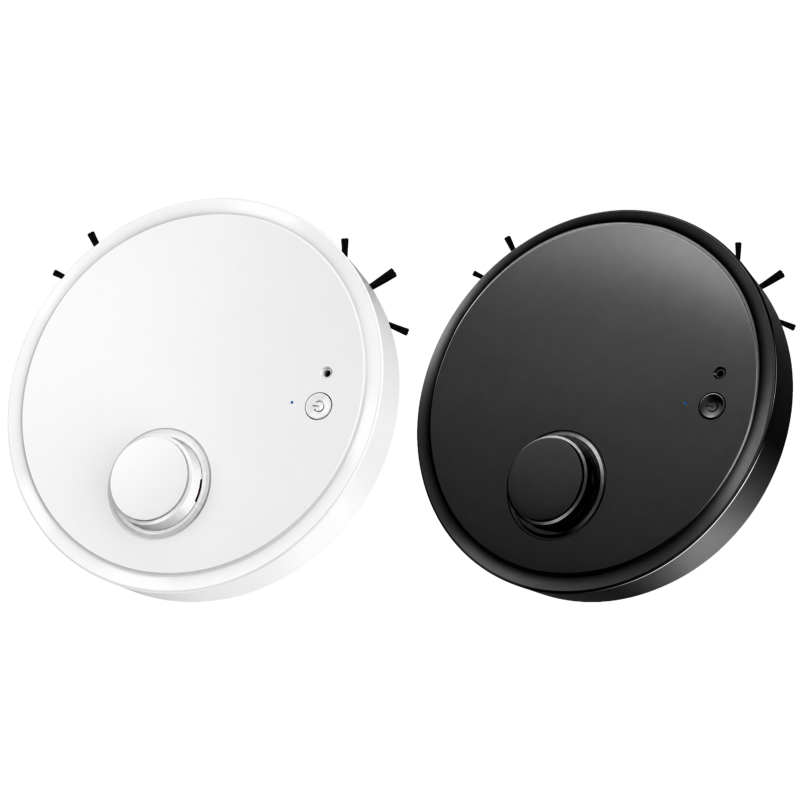
A 40 mm chassis gets under a 50 mm gap; every other robot in our own range stands 68–93 mm and stops at the skirting board. An ultra-slim robot vacuum is a low-profile robotic floor cleaner — this one measures 248 × 248 × 40 mm, pulls 1200 Pa, and sweeps, vacuums and mops in a single pass. Model UAHRC10 lands from $10.24 per unit.
// 01 — Key takeaways
Body height of UAHRC10. Built on our own seven assembly lines in a 15,000 m² plant in Guilin, staffed by 205 workers, and shipped with a 12-month warranty. Company details are set out on our Trust Center.
Rated suction from a 7.5 W high-speed DC motor. Sized for hard floors, thin rugs and daily dust, not for deep-pile carpet.
Runtime from a 3.7 V / 2400 mAh pack, recharged in about four hours over a 5 V–1 A USB cable.
Units per 40HQ container at 18 pieces per carton — 4.5 times what an 82 mm robot loads into the same box.
Per-unit price at the 500-piece tier. Standard MOQ is 100 units; custom tooling and packaging start at 1000.
// 02 — Definition
What an Ultra-Slim Robot Vacuum Is
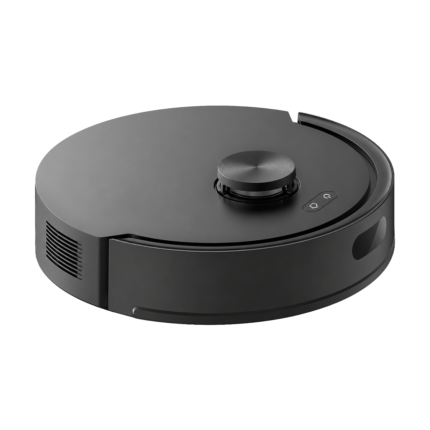
An ultra-slim robot vacuum is a robotic floor cleaner whose body is short enough to drive under furniture that blocks a standard unit. UAHRC10 is 40 mm tall and 248 mm across, weighs 0.55 kg, and combines sweeping brushes, a 177 ml dustbin and a mop cloth in one chassis.
How thin is 40 mm against a real furniture gap?
Height is the whole argument. A 40 mm body clears any gap above roughly 45 mm once you allow for carpet compression and floor level. Our 68 mm UAHRC08 needs 75 mm; the 82 mm UAHRC03 needs about 90 mm; the 93 mm UAHRC17 needs over 100 mm. Low beds, plinth-mounted kitchen cabinets, wardrobes and hotel bed frames sit squarely in the band that only the 40 mm unit reaches.
What does the slim body give up?
Volume. The dustbin holds 177 ml against 335 ml on UAHRC03 and 510 ml on UAHRC08. There is no charging dock in the box — the accessory list is main unit, two side brushes, a USB charging cable, a cleaning cloth, a manual and a screwdriver. Emptying is a daily task rather than a weekly one, which matters when you are writing the operating instructions for a hotel housekeeping team.
Which floors does it suit?
Tile, laminate, vinyl, sealed wood and thin rugs. On those surfaces this robot vacuum earns its place; the sweep-suction-mop module handles dust, hair and light grit in one pass. Deep-pile carpet is out of scope at this suction class, and a buyer who needs carpet performance should move up the range rather than argue with the specification.
// 03 — Suction
Is 1200 Pa Enough Suction?
For hard floors and daily maintenance cleaning, yes. 1200 Pa lifts dust, crumbs, pet hair and light grit off smooth surfaces. It is not enough for embedded dirt in medium or deep pile carpet, where the market convention is 2000 Pa and above and our own range reaches 20000 Pa.
What 1200 Pa moves
Pascals describe the pressure differential the robot vacuum fan can generate at the nozzle. On tile and laminate the debris sits on top of the surface, so a modest differential plus mechanical brush contact removes it. That is why a 7.5 W motor at 1200 Pa is a coherent specification for a maintenance robot and not a compromise dressed up as a feature.
Where 1200 Pa runs out
Carpet traps debris inside the pile. The fan then has to overcome the fibre as well as move air, and 1200 Pa loses that contest. Sand, cat litter and heavier grit on a rug will be pushed rather than lifted. If the target market is carpeted homes, the 1500 Pa UAHRC03 or the 20000 Pa UAHRC17 is the honest recommendation.
Why the Pa number alone predicts little
Suction is one variable among several: brush geometry, airflow path, nozzle clearance and travel speed all change the result. This is exactly why the standards world measures robots as systems. IEC/ASTM 62885-7 defines repeatable test methods for dry-cleaning robots and states plainly that its data compares robots with other robots, never with a manually pushed vacuum. Ask a supplier which method produced a headline figure before you put it on a retail box.
Height is the only specification on a robot vacuum a buyer cannot fix later. You can trade up on suction next season. A 68 mm chassis will never get under a 50 mm gap.
— Mi Lan, Founder, Guilin Use at Home Technology Co., Ltd.
// 04 — Specifications
UAHRC10 Spec Sheet
UAHRC10 runs a 7.5 W high-speed DC motor at 1200 Pa, a 3.7 V / 2400 mAh lithium pack good for about 70 minutes, and a 177 ml dustbin, inside a 248 × 248 × 40 mm body weighing 0.55 kg. The figures below are the catalogue values that go on a quotation.
UAHRC10 spec sheet
Rev. 2026.09
| Spec | This model | Why it matters |
| Product size | 248 × 248 × 40 mm | The 40 mm height is the reason this SKU exists |
| Suction power | 1200 Pa | Hard floors and thin rugs, not deep pile |
| Motor power | 7.5 W | Low draw keeps the 70-minute runtime realistic |
| Battery capacity | 3.7 V / 2400 mAh | 8.9 Wh — a single-cell pack, simple to ship |
| Working time | ≈ 70 min | Covers one floor of a flat or a hotel room block |
| Charging | 5 V–1 A, ≈ 4 hours | USB cable in the box; no dock to site or replace |
| Dustbin capacity | 177 ml | Daily emptying; write it into the user instructions |
| Noise level | ≤ 80 dB(A) | Louder than the 70 dB(A) larger models — schedule daytime runs |
| Net weight | 0.55 kg | One-hand carry between rooms and floors |
| Colours | White, Black | Both available at standard MOQ |
Battery and runtime
The pack is a single 3.7 V cell at 2400 mAh, about 8.9 Wh. That drives roughly 70 minutes of cleaning. UAHRC08 carries 3000 mAh for about 80 minutes, so the slim body costs around ten minutes of runtime rather than half the working day.
Charging over 5 V USB
Charging is 5 V–1 A over the supplied cable and takes about four hours. There is no infrared return-to-dock module, which is the trade for the 40 mm profile. For retail packaging this is a plus: no dock means a smaller carton and no regional adapter to source.
Noise and dustbin volume
Rated noise is up to 80 dB(A), higher than the 70 dB(A) of UAHRC08 and UAHRC03 because a shallow air path is a noisier air path. Pair that with the 177 ml bin and the operating pattern is clear: short scheduled daytime runs, emptied after each cycle.
// 05 — Navigation
How Does Random Navigation Change Coverage?
UAHRC10 uses random navigation: it drives until it meets an obstacle, turns, and carries on. Coverage still happens, but it takes far longer than a planned path. Budget a longer or a repeated cycle, and set that expectation in the product listing rather than after the returns start.
Robot vacuum navigation: random, pedometer and gyroscope
Three navigation classes appear in this price band. Random bounces off obstacles with no memory of where it has been. Pedometer planning, as on UAHRC08, counts wheel revolutions to hold a rough pattern. Gyroscope plus pedometer, as on UAHRC03, adds an angular reference so the machine tracks turns and runs recognisable lanes. Laser navigation on UAHRC17 maps the room outright.
The runtime penalty in numbers
The gap is documented. iRobot’s US Patent 7,188,000 states that a random-motion robotic device must run approximately five times longer than a deterministic device with similarly sized cleaning mechanisms moving at the same speed. Against a 70-minute battery, that is the single most useful sentence a buyer of a random-navigation robot can read.
When random is the right specification
Small, uncluttered areas. A studio flat, a single hotel room, an office under-desk zone, a caravan. In a 15 m² room the coverage penalty is absorbed inside one charge. In a 90 m² open-plan house it is not, and the buyer should be sold a planned-path model instead. Selling a random robot into the wrong floor area is the fastest way to earn a one-star review.
// 06 — Range
Which Model Fits Which Programme
Four robot vacuum models cover the range, from a 40 mm impulse-price unit to a 93 mm laser flagship. Height, suction and price move together. The matrix below carries catalogue figures from each model’s own record; per-unit prices are the lowest published tier for that SKU.
| Model | Height | Suction | Battery / runtime | From $/unit |
|---|---|---|---|---|
| UAHRC10 Slimmest | 40 mm | 1200 Pa | 3.7 V / 2400 mAh · ≈ 70 min | $10.24 |
| UAHRC08 | 68 mm | 1200 Pa | 3.7 V / 3000 mAh · ≈ 80 min | $16.85 |
| UAHRC03 | 82 mm | 1500 Pa | 7.4 V / 3000 mAh · ≈ 90 min | $36.05 |
| UAHRC17 | 93 mm | 20000 Pa | 3000 mAh | $126.46 |
UAHRC10 — 40 mm, lowest landed cost
Random navigation, app control, no dock, 177 ml bin. It wins on two numbers only: 40 mm of height and a sub-$11 unit cost. That is enough to build a promotional line or an amenity programme around.
UAHRC08 — 68 mm with pedometer planning
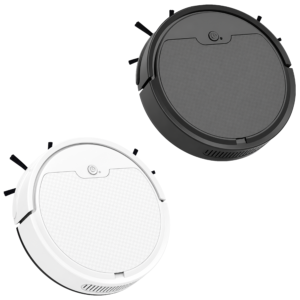
Two obstacle-avoidance modules, three anti-drop sensors, Bluetooth app control with timer scheduling and direction control, a 510 ml bin and 80 minutes of runtime. It is the step up for buyers who need a pattern rather than a bounce, at $16.85 per unit at 5000 pieces.
UAHRC03 — 82 mm with dock and water tank
Gyroscope plus pedometer navigation, a brushless DC motor at 1500 Pa, HEPA filtration, a 130 ml water tank, infrared return-to-charge and a WiFi app with ten-language switching. MOQ is 360 units and the price is $36.05 at 1000 pieces. This is the model for carpeted markets.
UAHRC17 — 93 mm laser flagship
Laser navigation with path planning, 20000 Pa, 45 W rated power, a 350 ml two-in-one tank, 20 mm obstacle climbing and a dust-collection charging base. MOQ is 500 units at $130.37, falling to $126.46 at 3000. It belongs in a specialist or premium channel, not next to the slim unit on a promotional endcap.
// 07 — Logistics
What Does a 40 mm Body Do to Freight?
It changes the landed cost more than the unit price does. A flat product packs flat, and container utilisation is where a low-value SKU either works or does not. The figures below come from our own packing specification for these two models.
Carton and container maths
Per unit, UAHRC10 occupies 0.00647 CBM against 0.0295 CBM for UAHRC03. Carton size is 730 × 285 × 560 mm at 16.4 kg gross for 18 pieces. A 20ft box takes 4,230 units and a 40ft takes 8,766. On an ocean rate quoted per CBM, that spread is worth several dollars a unit on a product that sells for ten.
Lithium batteries after 1 January 2026
The 3.7 V / 2400 mAh cell ships installed in the unit. From 1 January 2026 the IATA lithium battery rules extend the 30 percent state-of-charge cap to cells packed with the equipment they power, not only to loose cells. For air freight, plan for UN 38.3 documentation and a partially charged pack. Sea freight remains the sensible route for a container-scale order of this SKU anyway.
// 08 — Fit
Who Should Shortlist UAHRC10
Three buyer types get real value from a 40 mm robot vacuum at this cost: discount retail running a seasonal price point, hospitality buying an in-room amenity, and private-label brands testing a robot category without committing to tooling.
Discount and grocery retail
A sub-$11 factory cost supports an aggressive shelf price in a category shoppers associate with three figures. The proposition on the box is height, not power: it goes where your other one cannot. That is a claim the product actually delivers.
Hotel and serviced-apartment amenity
Hotel bed frames and low units are precisely the 45–90 mm band that blocks a standard robot vacuum. A 0.55 kg unit that charges from any USB port and needs no docking station is easy to deploy across a floor of rooms. Housekeeping empties the 177 ml bin between turnovers.
Private-label starter lines
Standard MOQ is 100 units in white or black, which is small enough to run a market test. Custom colour, packaging and branding start at 1000 units. Buyers usually run the 100-unit standard SKU first, then move to custom once the sell-through rate is known.
// 09 — Manufacturing
How We Manufacture This Robot Vacuum
UAHRC10 is built in our own facility in Guilin, Guangxi — 15,000 m², seven assembly lines, 205 workers and capacity for 100,000 units a month. Nothing in this SKU is bought in and rebadged. The four stages below are the route every unit takes.
In-house tooling and molding
The 40 mm shell is the hard part. Holding a 40 mm stack height while housing the fan, brush drive, bin and battery leaves almost no tolerance, so the housing runs on our own moulds rather than a shared tool.
Motor and PCBA burn-in
The 7.5 W high-speed DC motor and the control board are powered and run before assembly. Cells are matched to the 3.7 V / 2400 mAh specification and charge-cycled on the 5 V–1 A profile the customer will use.
Suction and drive testing
Assembled units are run for suction at the nozzle, brush rotation, anti-drop response and mop-plate fit. Height is gauged on the line, because a shell that comes out of tolerance stops being an ultra-slim robot vacuum at all.
Compliance and warranty
We build to CE, RoHS, FCC and UN 38.3 for the battery, and issue the certificates and test reports relevant to each order. Every unit carries a minimum 12-month warranty. The marks we hold are listed on the Trust Center.
// 10 — Commercial
Pricing, MOQ and Lead Time
Published tier pricing runs from $10.58 at 50 pieces to $10.24 at 500. Standard MOQ is 100 units; custom work starts at 1000. Lead time is 15–30 days from a confirmed order, and terms are FOB China with EXW and CIF available.
UAHRC10 tier pricing
USD / unit
| Quantity | Discount | Price per unit |
| 50 | — | $10.58 |
| 100 | $0.09 | $10.49 |
| 300 | $0.26 | $10.32 |
| 500 | $0.34 | $10.24 |
What the tiers actually move
The spread across the whole table is 34 cents, or 3.2 percent. On this SKU the money is not in the tier ladder — it is in the freight, which is why the container figures above matter more than the discount column.
MOQ and customisation
100 units gets the standard white or black unit in stock packaging. 1000 units opens custom colour, logo, retail carton, manual and accessory set. Both colours are available at the standard MOQ, so a first order can split across the two.
Incoterms, payment and lead time
FOB China is the default, with EXW and CIF quoted on request. Payment is 30/70 T/T, and Alibaba Trade Assurance is available for buyers who want the order held under an escrow contract. Production runs 15–30 days depending on volume and whether the order is standard or custom.
// 11 — Questions
Frequently Asked Questions
The questions below are the ones that decide a first order on this SKU: height, suction, charging, minimum quantity, container loading and battery transport. Each answer uses the catalogue figures from the UAHRC10 record.
How tall is the UAHRC10 ultra-slim robot vacuum?
Is 1200 Pa enough for hard floors and thin rugs?
Does the robot return to a charging dock by itself?
What is the MOQ and can the unit be private-labelled?
How many units fit in a 40 ft high-cube container?
Does the lithium battery restrict shipping?
// 12 — Verdict
The Decision in One Line
Buy UAHRC10 when the selling point is access, not power. At 40 mm and $10.24 a unit it reaches floor area no other robot vacuum in the range can touch, and it loads 10,278 pieces into a 40HQ. Buy up the range when the floor is carpeted.
The specification is coherent rather than compromised: a 7.5 W motor, 1200 Pa, a 177 ml bin, random navigation and USB charging are all consequences of the 40 mm decision. Sold as a low-profile maintenance robot for hard floors, it does exactly what the box says. Sold as a general-purpose cleaner for a carpeted house, it will disappoint, and the returns will tell you so.
Full technical data sits on the UAHRC10 product page, and the rest of our appliance range is at Use At Home.
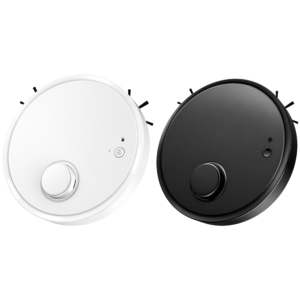
// Featured model — UAHRC10
Fully Automatic Ultra-Slim 1200Pa Robot Vacuum Cleaner and Mop
248 × 248 × 40 mm · 1200 Pa · 7.5 W · 3.7 V / 2400 mAh, ≈ 70 min · 177 ml bin · sweep, suction and mop in one pass
Factory direct from $10.24/unit · MOQ 100
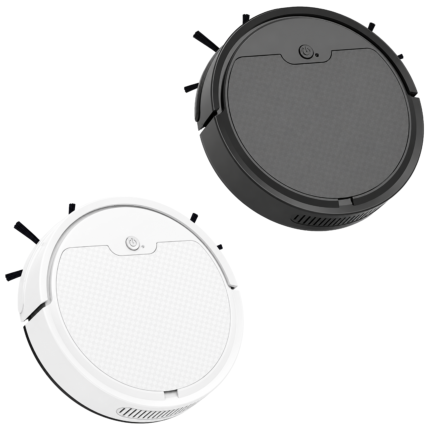
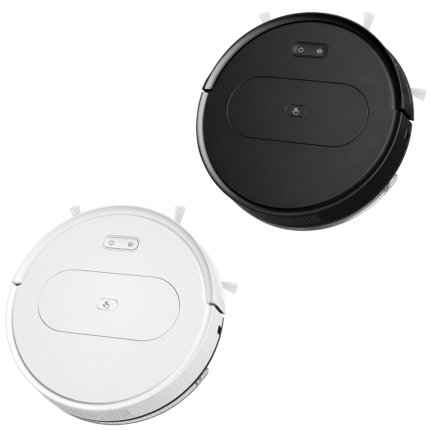
Similar Products
Ready to order or need a wholesale quote?
Use At Home manufactures these appliances direct from our Guilin, China factory — OEM, private-label and B2B welcome. Tell us your market and volume.